
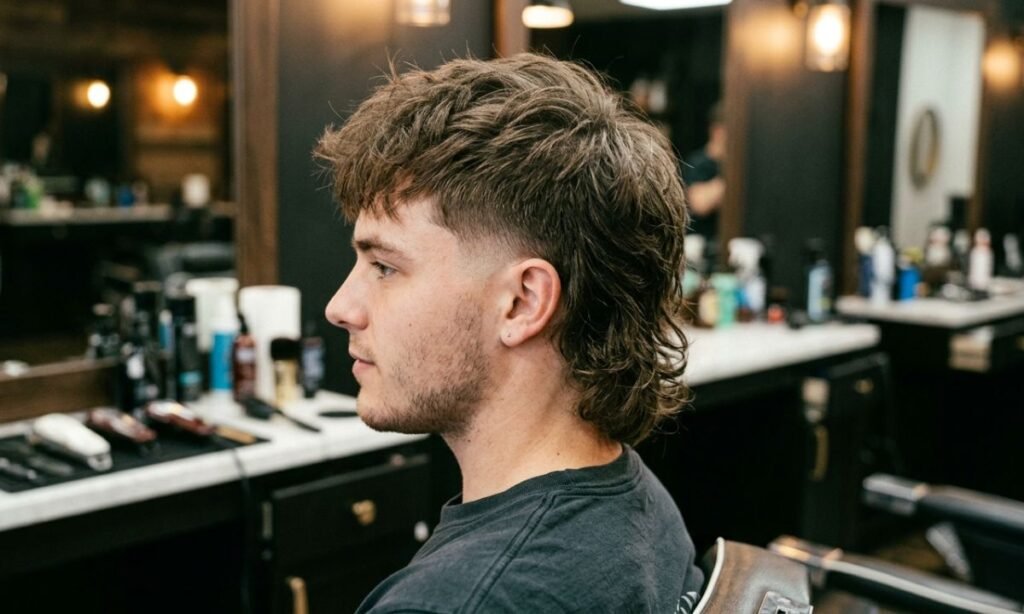
The low taper mullet haircut offers that combination, blending clean edges with a longer back and a versatile top.You can wear it with natural curls, a textured fringe, messy layers, or a neatly styled finish.The best part is that you don’t need to copy an extreme mullet to enjoy this look.
In this guide, you’ll learn how to choose the right variation, explain your preferred cut to a barber, and maintain the shape between appointments.
We’ll also compare popular mullet styles and cover the products that make everyday styling easier.
What Is a Low Taper Mullet?
A low taper mullet is a haircut that keeps the hair longer at the back while gradually shortening the hair around the sideburns and neckline.
The top can have different lengths, depending on whether you prefer a classic finish, loose texture, or natural curls.
Its defining feature is the low placement of the taper, which creates a cleaner outline without removing too much hair from the sides.
Unlike a high fade, a low taper concentrates the shortest sections near the bottom of the haircut.
This creates a subtle transition that allows the longer sections to remain the main feature.
You can also choose a low taper fade mullet if you prefer a more noticeable blend around the edges.
The exact result depends on the barber’s technique, your hair texture, and how much length you want to preserve.
Who Should Try a Low Taper Mullet?
A low taper mullet suits people who want something more distinctive than a standard short haircut.
It’s particularly appealing if you enjoy modern men’s hairstyles but still want the sides and neckline to look tidy.
Your natural hair texture can help determine which variation works best.
Straight hair can create a sleek outline, wavy hair adds movement, and curls give the top and back extra volume.
Face shape is another useful consideration, although it shouldn’t dictate your entire decision.
If you have a round face, some height at the crown may create a more elongated appearance.
If your face is longer, a fuller fringe can help balance the proportions.
People with oval faces have plenty of flexibility when choosing between short fringes, textured tops, and longer backs.
Your daily routine matters just as much.
If you prefer spending only a few minutes on your hair, choose a variation that works with your natural growth pattern instead of requiring extensive styling.
Benefits of a Low Taper Mullet
One advantage of a low taper mullet is its adaptability.
You can keep the sides understated or make the longer back more noticeable with layers, curls, or extra texture.
The low taper also gives the haircut a cleaner outline around the ears and neckline.
Another benefit is the range of styling options available.
A classic version can look relatively simple, while a messy variation creates a more relaxed appearance.
You can also combine the haircut with a fringe, subtle highlights, or a beard.
However, versatility doesn’t mean every variation suits every person equally well.
The barber needs to consider your hair density, growth direction, and preferred length before shaping the cut.
With the right proportions, a low taper mullet can feel distinctive without becoming unnecessarily difficult to manage.
5 Best Low Taper Mullet Hairstyles
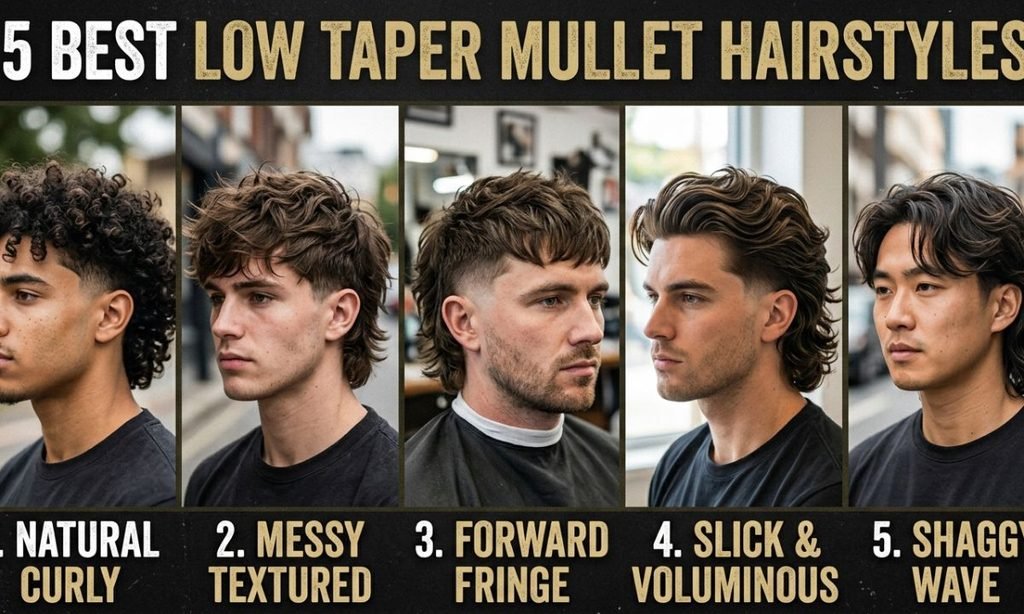
Not every mullet needs dramatic length or an aggressive fade.
These five variations offer different ways to wear the same basic haircut, whether you prefer something subtle or more expressive.
Classic Low Taper Mullet
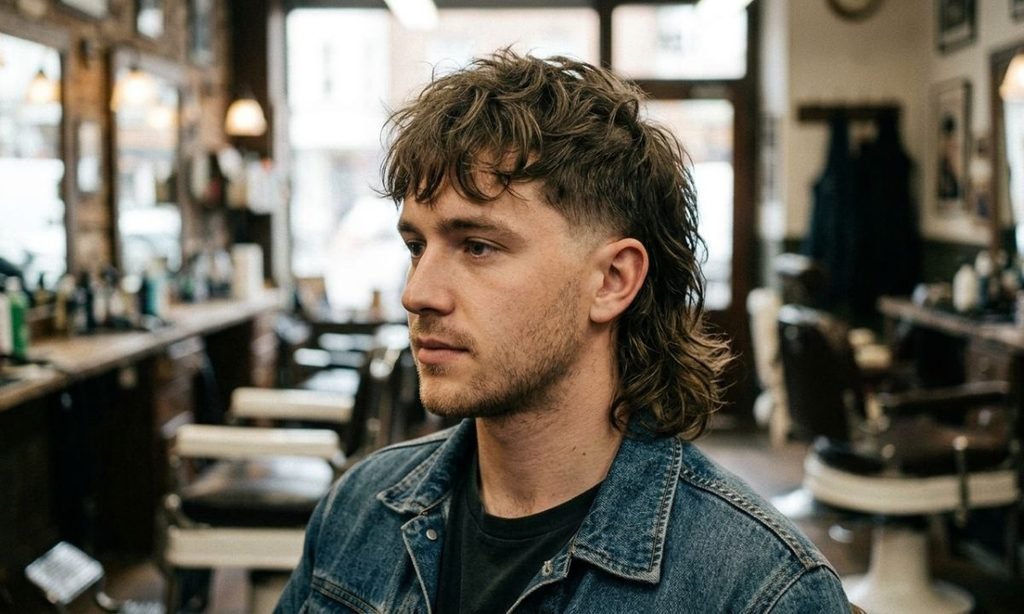
The classic low taper mullet keeps the top relatively simple and leaves enough length at the back to establish the traditional mullet shape.
The sides taper gently near the ears, while the neckline stays neat without looking overly sharp.
This variation is a sensible choice if you’re trying a mullet for the first time.
It provides a recognizable profile without relying on extreme contrast or complicated styling.
Ask your barber to preserve the back length and create a gradual transition around the sideburns.
A little lightweight styling cream can help control flyaways while keeping the finish natural.
Textured Low Taper Mullet
A textured low taper mullet adds movement through the top and crown.
The barber creates layers that allow individual sections to separate instead of sitting flat against the head.
This variation suits people who prefer a relaxed finish with some volume and definition.
It can work especially well with straight or wavy hair that needs additional movement.
For styling, rub a small amount of matte paste between your palms and work it through dry hair.
Lift a few sections with your fingertips, then let the remaining strands fall naturally.
The aim is controlled texture rather than making every section look deliberately messy.
Curly Low Taper Mullet
A curly low taper mullet uses natural curls to create volume across the top and back.
The tapered sides keep the overall shape controlled while the longer sections provide definition.
This variation can suit loose waves, springy curls, and tighter curl patterns when the cut is tailored appropriately.
Ask your barber to account for shrinkage before deciding how much length to remove.
Curly hair can appear significantly shorter after drying, which affects the final silhouette.
For daily styling, apply a suitable curl cream to damp hair and distribute it evenly.
Scrunch gently and allow the curls to dry without repeatedly disturbing them.
Low Taper Mullet With Fringe
A low taper mullet with fringe changes the haircut’s appearance by adding a defined front section.
You can choose a short, uneven fringe for a casual look or a longer fringe for more coverage.
A curtain-style fringe offers another option if you prefer the hair to part near the middle.
The right choice depends on your forehead, hairline, and natural growth direction.
If your hair naturally falls forward, a textured fringe may require very little daily effort.
If your hair grows upward, ask your barber whether a different fringe length would be easier to manage.
Keep the styling product lightweight so the fringe retains its movement instead of becoming stiff.
Low Taper Fade Mullet With Beard
A low taper fade mullet with beard combines a clean lower outline with longer hair at the back and facial hair.
The beard adds another element to the overall shape, creating a connection between the sideburns and jawline.
You can choose a short beard, neatly trimmed stubble, or a fuller style depending on your preference.
Ask your barber to blend the sideburn area carefully so the haircut and beard look connected.
A soft transition creates a more natural appearance, while a sharper outline makes the finish more defined.
Keep the beard’s shape balanced with the volume on top.
You don’t need a thick beard to wear this variation successfully.
How to Style a Low Taper Mullet
A good styling routine begins with understanding what your hair naturally does.
Straight hair may need help holding texture, while curly hair often needs moisture and gentle handling.
Start with a small amount of product and increase it only when necessary.
Everyday Casual Style

For an everyday finish, keep the routine straightforward.
Wash your hair when needed, remove excess water with a towel, and apply a small amount of lightweight cream if necessary.
Use your fingers to arrange the top and crown without forcing every strand into place.
Let the back follow its natural direction rather than flattening it against your head.
This approach works well when you want a relaxed hairstyle that doesn’t look overly styled.
Professional Finish
A polished finish creates a cleaner appearance without removing the mullet’s distinctive shape.
Start with slightly damp hair and use a blow-dryer on a moderate setting.
Guide the top into position with your fingers or a suitable brush.
Apply a small amount of light-hold cream to control loose strands.
Keep the finish flexible rather than stiff, especially if you want the hair to move naturally throughout the day.
Messy Textured Look

A messy finish works best when the top has enough layers to create separation.
Apply a little matte styling paste to dry hair and spread it evenly through the top.
Lift selected sections around the crown and use your fingertips to create definition.
Avoid applying too much product because it can make the hair look greasy.
If your hair is naturally flat, ask your barber whether additional layers could help create the shape you want.
Curly Finish
Curly hair usually looks better when you preserve its natural pattern.
After washing, apply a suitable leave-in conditioner or curl cream while your hair remains damp.
Scrunch the curls gently and let them dry naturally or use a diffuser on a suitable setting.
Avoid brushing the finished curls because it can separate the strands and increase frizz.
Once dry, adjust only the sections that need extra definition.
Best Hair Products for a Low Taper Mullet
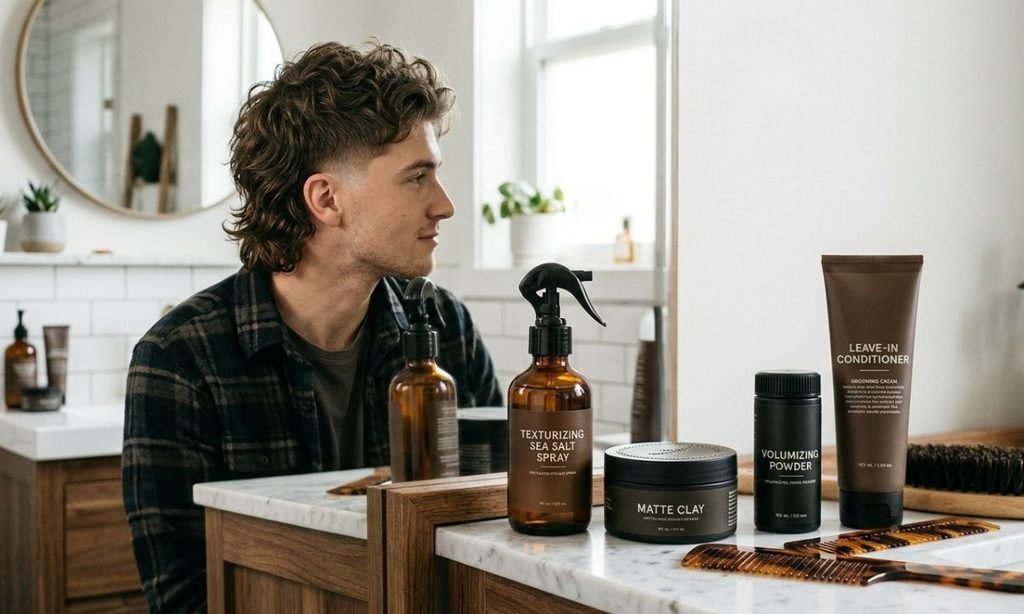
You don’t need an entire shelf of products to style a low taper mullet.
The best choice depends on your hair texture, desired finish, and how much control you need.
Start with one suitable product and build your routine only when necessary.
Product
Different products serve different purposes, so choose according to your styling needs.
| Product | Best Use |
| Matte styling paste | Creating texture and separation |
| Lightweight styling cream | Controlling flyaways with a natural finish |
| Curl cream | Defining curls and managing frizz |
| Leave-in conditioner | Adding moisture to dry lengths |
| Heat protectant | Helping reduce heat-related damage |
| Light-hold hairspray | Providing additional hold when needed |
Purpose
Fine hair may become flat when you apply thick creams or heavy waxes.
A lightweight paste or styling cream can provide enough control without weighing down the top.
Thick or curly hair may benefit from richer conditioning products that improve manageability.
If you regularly use a blow-dryer, apply a suitable heat protectant according to the label instructions.
Remember that styling products cannot replace a well-shaped haircut.
If the back looks bulky or the top refuses to sit properly, ask your barber to assess the cut before adding more product.
Maintenance Tips
Maintaining a low taper mullet means keeping the edges tidy while allowing the longer sections to retain their shape.
Your exact routine will depend on how quickly your hair grows and how polished you want the haircut to look.
Visit Your Barber Every 4 to 6 Weeks
A trim every four to six weeks provides a useful starting point for maintaining the taper.
However, this isn’t a strict rule for everyone.
If you prefer sharp edges, you may want a quick cleanup sooner.
If you like a softer, grown-out finish, you can wait longer between appointments.
Tell your barber to refresh the taper without removing unnecessary length from the back.
Wash Hair Properly
Wash your hair according to your scalp’s needs rather than following a fixed schedule.
If your scalp becomes oily quickly, you may need to shampoo more often than someone with dry hair.
Massage shampoo gently into the scalp and rinse thoroughly.
Avoid rough handling, especially when the longer sections become tangled or frizzy.
Choose a shampoo suited to your scalp and hair texture instead of relying on products marketed only for a specific hairstyle.
Condition Regularly
Conditioner helps keep the longer sections soft and easier to manage.
Apply it mainly to the lengths and ends, especially if your hair feels dry.
Fine hair may respond better to lightweight formulas, while thick or curly hair may benefit from richer conditioning.
Rinse according to the product instructions to avoid unnecessary residue.
Avoid Heavy Styling Products
Too much wax or cream can flatten the crown and leave the hair looking greasy.
Start with a small amount and add more only when necessary.
If your hairstyle loses volume quickly, try a lighter formula with a natural finish.
Cleanse your hair regularly to prevent styling residue from building up.
Protect Hair From Heat
Frequent high-heat styling can leave hair dry and brittle.
Apply a suitable heat protectant before using a blow-dryer or other heated tools.
Keep the dryer moving instead of concentrating heat on one section for too long.
For curly hair, a diffuser can help maintain definition when used appropriately.
Allowing your hair to air-dry partially can also reduce the time spent using heat.
Low Taper Mullet vs Other Popular Mullet Haircuts
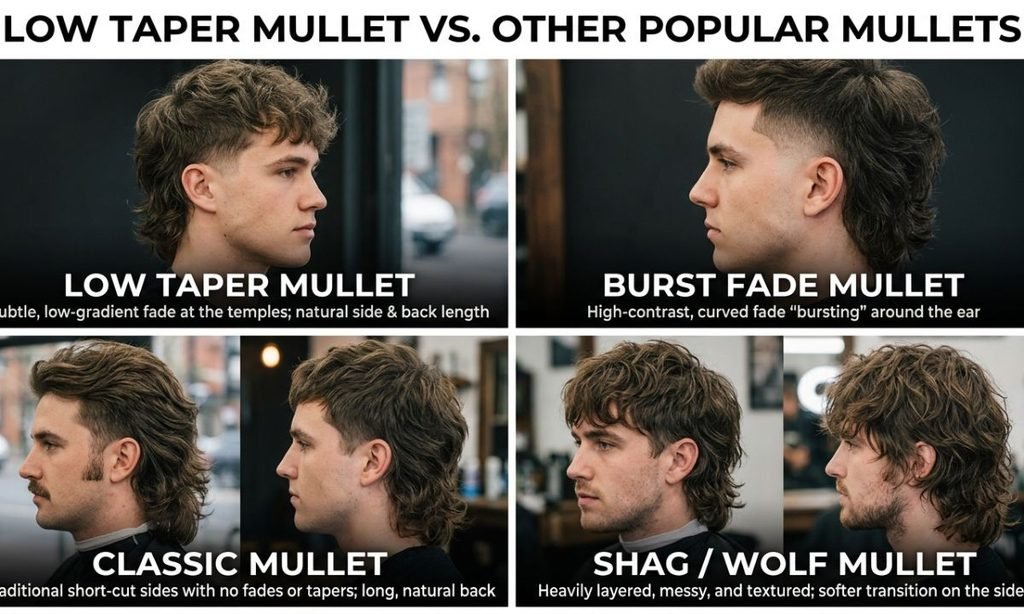
Different mullet styles can look similar in photographs, but their taper placement changes the final result.
Comparing the main features helps you choose a cut that matches your preferred level of contrast.
Feature
The most useful features to compare are taper placement, overall appearance, and maintenance needs.
A low taper focuses on the lower edges, while a mid taper moves the transition higher.
A burst fade creates a curved shape around the ears, producing a different side profile.
Low Taper Mullet
The low taper mullet creates a subtle transition around the sideburns and neckline.
It suits people who want a cleaner outline without making the sides the main feature.
You can combine it with a textured top, fringe, curls, or facial hair.
Mid Taper Mullet
The mid taper mullet places the transition higher on the sides.
This creates a more noticeable contrast than a low taper, although the result depends on the barber’s technique.
It can suit people who want a sharper profile while preserving the longer back.
Burst Fade Mullet
The burst fade mullet features a curved fade around the ears.
This creates a more distinctive side profile, particularly when paired with curls or a textured top.
It may require careful maintenance if you want the curved outline to remain crisp.
| Feature | Low Taper Mullet | Mid Taper Mullet | Burst Fade Mullet |
| Taper placement | Low around the edges | Higher on the sides | Curved around the ears |
| Overall appearance | Subtle and balanced | More contrast | Distinctive and bold |
| Styling options | Classic, textured, curly | Textured, polished | Curly, spiky, voluminous |
| Maintenance | Depends on desired sharpness | Depends on desired sharpness | Curved fade may need regular cleanup |
| Suitable preference | Softer transition | More visible contrast | Rounded fade around the ears |
Pros and Cons of a Low Taper Mullet
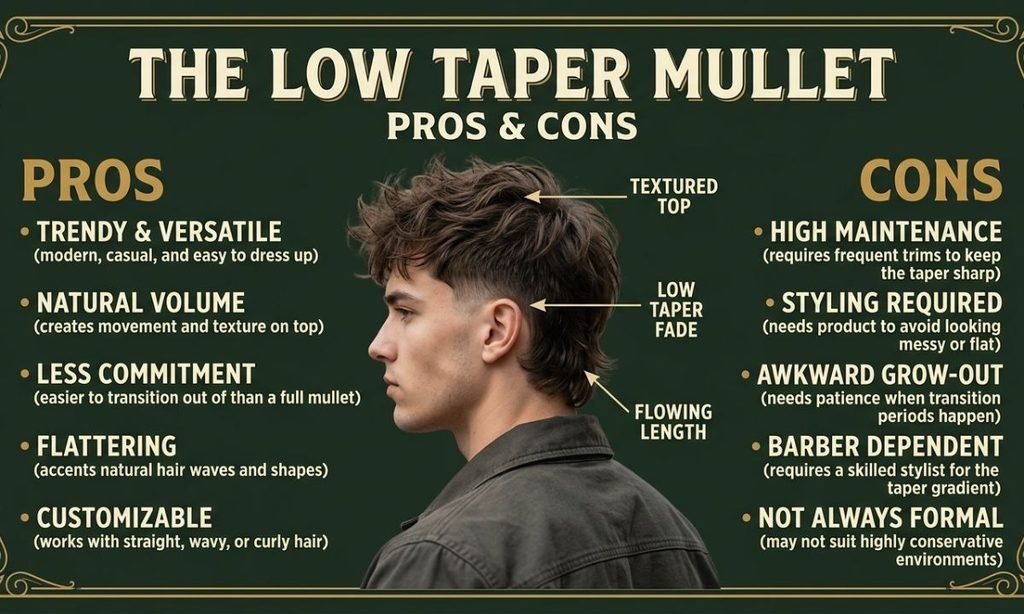
A low taper mullet offers several styling options, but it still requires a suitable cut and some maintenance.
Think about your daily routine before deciding whether this hairstyle fits your needs.
Pros
- Versatile styling: You can choose classic, curly, textured, or fringe-based variations.
- Clean edges: The low taper keeps the sideburns and neckline controlled.
- Texture flexibility: Suitable versions can be created for straight, wavy, and curly hair.
- Personal expression: The longer back gives the haircut a distinctive profile.
- Adjustable shape: Your barber can tailor the length and layering to your preferences.
Cons
- Regular trims: The tapered edges may need refreshing to stay sharp.
- Length management: The back can become uneven if it grows without reshaping.
- Styling time: Some textured variations require daily attention.
- Workplace preferences: A bold mullet may not suit every dress code.
- Growing-out stage: The transition can look less balanced while the hair changes length.
Fine hair often benefits from preserving fullness instead of removing too much hair.
Ask your barber to assess your density, growth direction, and preferred length before choosing the final variation.
FAQs About the Low Taper Mullet
What Is a Low Taper Mullet?
A low taper mullet keeps the hair longer at the back while gradually shortening the hair around the sideburns and neckline.
The top can be straight, wavy, curly, or textured.
Its defining feature is the combination of a low taper and a longer back.
Is a Low Taper Mullet Suitable for All Hair Types?
A low taper mullet can be adapted to straight, wavy, curly, and coily hair.
The best version depends on your hair density, growth pattern, and preferred length.
A barber can adjust the layers and proportions to suit your natural texture.
How Often Should I Trim a Low Taper Mullet?
A trim every four to six weeks is a reasonable starting point for maintaining the taper.
You may need more frequent cleanup if you prefer sharp edges.
If you like a softer, grown-out appearance, you can wait longer.
Which Face Shape Looks Best With a Low Taper Mullet?
A low taper mullet can work with oval, round, square, and longer face shapes.
The result depends on how the barber balances the top volume, fringe, and back length.
For round faces, added height may create a more elongated appearance.
For longer faces, a fuller fringe can help balance the proportions.
What Products Should I Use for a Low Taper Mullet?
Matte paste works well for textured styles, while lightweight cream provides softer control.
Curly hair may benefit from curl cream or leave-in conditioner.
Use heat protectant if you regularly blow-dry your hair, and avoid heavy products if they flatten the top.
Can I Get a Low Taper Mullet With Short Hair?
Yes, although the back needs enough length to create a recognizable mullet shape.
If your hair is very short, you may need to grow the back before achieving your preferred style.
You can keep the sides neat while the longer sections develop.
Is a Low Taper Mullet Easy to Maintain?
Maintenance depends on your hair texture, chosen variation, and preferred finish.
A simple version may require little daily styling, while a sharp taper needs more frequent cleanup.
Choose a variation that fits your schedule and styling preferences.
Final Thoughts
The low taper mullet combines clean edges with a longer back, giving you room to choose a style that feels personal.
You can keep it classic, add texture, embrace your curls, or pair it with a fringe and beard.
The best choice depends on your natural hair, preferred silhouette, and daily routine.
Bring a clear reference photograph to your barber and explain how much length you want to preserve.
With the right proportions and a manageable routine, a low taper mullet haircut can look distinctive without becoming difficult to maintain.

3 thoughts on “Low Taper Mullet Haircut: Stylish Ideas and Tips for 2026”